
Top Signs You Need Garage Door Service – Don’t Ignore These
A garage door doesn’t just break. It tells you it’s about to break, usually for weeks, through sounds, speeds and movements that have precise mechanical meanings if you know what you’re hearing. Most homeowners wait until the door stops moving entirely, then call it an emergency. In our experience, the repair that could have been a quick adjustment becomes a snapped spring or a burned-out opener motor. Here are the signals worth taking seriously, and what each one means for the system behind it. If you’d rather not diagnose it yourself, call (855) 645-1112 and we’ll take a look.
What Do the Noises Coming From Your Garage Door Actually Mean?
Different sounds point to different failing parts, and each has its own timeline before real damage sets in. A squeak is the mildest and a grind is the most urgent.
- A squeak or squeal usually means dry hinges, rollers or a dry torsion shaft. It’s a lubrication issue, and left alone it wears the moving parts faster than they should wear. You’ve got time, but not unlimited time.
- A grinding sound points to a worn bearing or a roller that’s lost its surface. Grinding tends to get worse over a matter of weeks, and it drags on the opener motor the whole time.
- A pop or bang is the one to take seriously. It often signals cable tension trouble or a torsion problem, and a torsion spring that’s about to let go. That pop can be the spring snapping.
If you’re hearing a squeak, it’s the cheapest fix on this list. A grind means a bearing or roller is your culprit, and it’s adding strain to the opener every time the door moves. A pop is different: that’s cable or spring territory. Torsion and extension springs sit under extreme tension, and they’re the most dangerous part of any garage door system. We handle those so you don’t have to. In Ormond Beach, a door that’s been quiet for a while and suddenly pops is worth a same-day look before it fails shut.
Why Is Your Door Slow Going Up but Fast Coming Down?
That speed difference is one of the clearest diagnostic signals a garage door gives you. A door that labors on the way up but drops quickly on the way down is telling you the springs have lost tension. They’re supposed to counterbalance the door’s weight, and when they weaken, the door fights gravity going up and surrenders to it coming down.
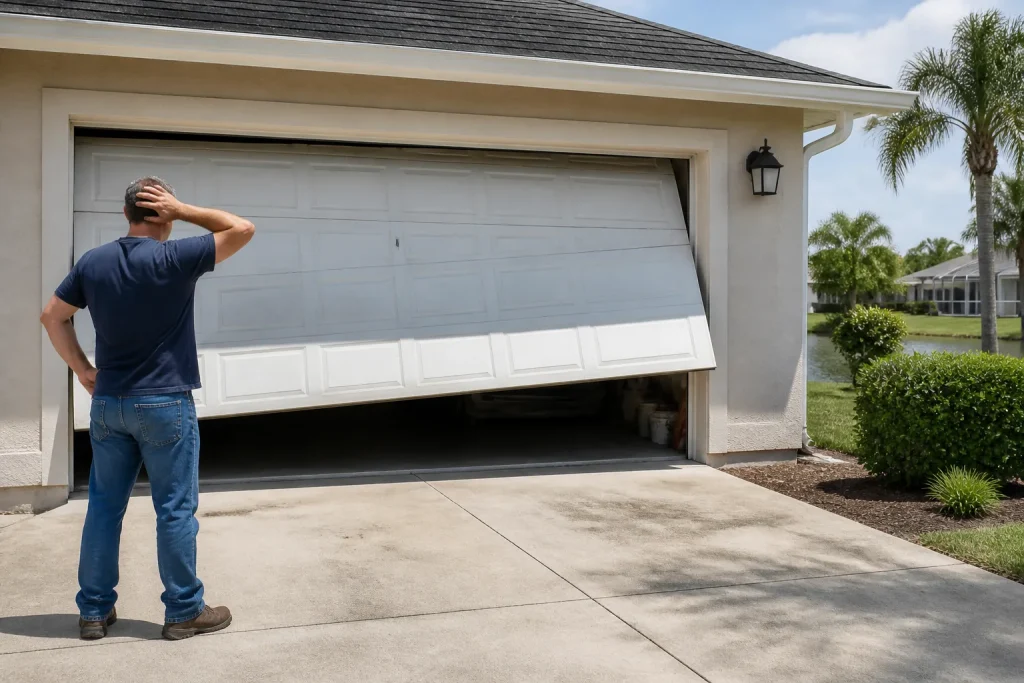
The counterbalance is the whole point of the spring system. When it fades, the opener motor picks up the slack, and it isn’t built for that. Left alone, the pattern usually runs like this: the door gets slower and heavier, the opener works harder, and eventually the spring snaps or the opener burns out trying to lift a door it was never meant to carry alone. A snapped spring can leave the door stuck down or, worse, drop it hard.
This is where it pays to know the brand on your door. We work on LiftMaster, Chamberlain, Genie, Clopay, Amarr, Wayne Dalton, Craftsman and Raynor systems, so we’re not guessing at how yours was built. If your door has started behaving differently between up and down, that’s the moment to book a garage door repair rather than waiting for the failure. We serve homeowners across Ormond Beach who notice this exact pattern before anything actually breaks.
The 30-Second Balance Test That Tells You if Your Springs Are Failing
You can check your springs without tools, and it takes about half a minute. Close the door, pull the release handle to disconnect the opener, then lift the door by hand to about waist height and let go. A healthy door holds its position or drifts only slightly. A door that drops on its own, or feels unusually heavy to lift, is running on tired springs.
- Close the door and pull the opener release so the door moves freely by hand.
- Lift the door to roughly waist height and stop.
- Let go and watch. Drifting down or a heavy lift both mean the springs are losing tension.
- Reconnect the opener only after the door is fully closed.
This is a check, not a repair. Do not reach up and touch the springs, cables or the torsion shaft while the door is under tension, and don’t try to adjust anything yourself. Springs are the most dangerous part of the system, and they’re a job for someone trained to handle them. What the test gives you is information: if the door won’t hold its position, you know it’s time to call rather than wait for it to break. In Ormond Beach, a failed balance test is one of the most common reasons people reach out to us for garage door spring repair.
Is It the Door or the Opener? Reading Motor Strain
When the opener starts sounding louder or running longer than it used to, the problem is usually in the door, not the opener. The motor is the messenger, not the culprit. It’s working harder because something in the door’s mechanical system has gotten stiff, heavy or out of balance, and the opener is compensating.
Watch for these signals:
- The opener runs noticeably longer to complete a cycle.
- The motor hums or grinds louder than it used to.
- The door reverses partway through travel and goes back down.
- The opener strains on the first lift of the day, then eases off later.
It’s tempting to assume the opener needs replacing. Often it doesn’t; the door does. A trained look at the whole system tells you which. If your opener is a Genie, Chamberlain or Craftsman unit, the diagnostics differ slightly by model, and it helps to have someone who knows your equipment. When we check a door in Ormond Beach, we look at the springs, rollers and track before blaming the motor, because a strained opener is frequently the symptom of a door that’s stopped being easy to move. That check falls under garage door opener repair, and it’s worth doing before you spend money on a new motor. A short checklist anywhere in the eight brands we service saves the guesswork.
The Ormond Beach Warning Sign: Oxidation on the Spring Coils
Look at the coil of the torsion spring above the door. Surface rust on the outside can look cosmetic, but in our experience around Ormond Beach, that dull orange coating on the coil often signals internal fatigue. The spring can be weaker than it looks, and the rust pattern can hide how close it is to snapping.
Ormond Beach sits in a climate where humid air and warm temperatures keep metal working against itself year-round. That’s why oxidation on the coils is worth taking seriously here. A spring can look fine from the outside and be well into its fatigue on the inside. If you see heavy discoloration, flaking or a coil that looks pitted, don’t wait for a pop to tell you it’s done.
This is also why we don’t judge a spring by its paint. When we look at a door in Ormond Beach, we’re checking the coil for signs the metal has been stressed, not just what it looks like. Springs are the part of the system we take the most care with, because a failure here isn’t a small inconvenience. It’s a door that drops, and it can be dangerous. If the coil above your door is looking rough, call us and we’ll check it. Call (855) 645-1112. We answer 24/7, and fast dispatch runs from 7am to 7pm, Sunday through Friday.
When to Call a Pro (and When You Can Wait)
Some signs are worth a call right away, and others can wait for a scheduled visit. Here’s how we’d sort them.
- Call right away: a pop or bang, the door dropping fast, a door stuck open (your home is exposed) or stuck closed, a snapped spring, or the door coming off its track.
- Book a visit soon: grinding, a door that won’t hold the balance test, the opener straining, or a door that reverses partway.
- Start with lubrication: a squeak that hasn’t turned into anything else yet.
Emergency service is a core part of what we do, because a door that won’t close is a security gap, and a door that won’t open can trap a car. When your door won’t move, we will. We answer 24/7, and our crews are sent with fast dispatch from 7am to 7pm, Sunday through Friday; a call outside those hours gets booked into the next opening. We’re built for garage doors and nothing else, which means nobody’s learning on your door. If you’re in Ormond Beach and something on this list sounds familiar, call (855) 645-1112. Let’s get it looked at before it gets worse.
The Bottom Line
Most garage door failures announce themselves well before they happen. A squeak, a grinding noise, a spring that won’t hold the door up, an opener working overtime and a rusty coil are all messages from the same mechanical system. The quicker you read them, the smaller and cheaper the repair tends to be. If you’re in Ormond Beach and need help, Ormond Beach Garage Door Repair Pros offers free estimates. Call (855) 645-1112. We answer 24/7, with fast dispatch from 7am to 7pm, Sunday through Friday.
Frequently Asked Questions
If the only symptom is a squeak, lubrication is usually enough. Grinding, a pop, a door that won’t hold the balance test or an opener running longer than it used to all point to a mechanical issue that needs a proper look.
It rarely does. Springs usually weaken and give signals first: a door that’s slow going up and fast coming down, a balance test that fails, or visible oxidation on the coils. A pop or bang is often the final moment rather than the first sign.
Grinding is a strain on the system but not an immediate hazard. Popping, a door dropping quickly or a snapped spring is a safety issue, and you should stop using the door until it’s checked by a trained professional.
Almost certainly. We work on LiftMaster, Chamberlain, Genie, Clopay, Amarr, Wayne Dalton, Craftsman and Raynor equipment, which covers most systems already installed in homes.
We answer 24/7. A call outside dispatch hours is booked into the next opening, Sunday through Friday, 7am to 7pm.
If something on this list has you concerned, call (855) 645-1112 for a free estimate. You can also start at Ormond Beach Garage Door Repair Pros to see the full range of what we do.
Written by the team at Ormond Beach Garage Door Repair Pros.
Need Garage Door Help?
Call Ormond Beach Garage Door Repair Pros - the local pro we connect you with is licensed and insured, here with fast help in Ormond Beach.
(855) 645-1112